Introduction
DC motors are widely used in modern motion systems because of their responsiveness, simple speed control, and compact design. From robotics and medical devices to automation and mobility systems, they deliver practical and reliable motion across industries.
How DC Motors Work?
So, how do DC motors work?
DC motors convert electrical energy into mechanical motion using electromagnetism. When current flows through the windings, it creates a magnetic field that interacts with the stator, rotating the shaft. This principle makes DC motors easy to control and widely used in series, shunt, compound, and PMDC types.
Key Components of a DC Motor
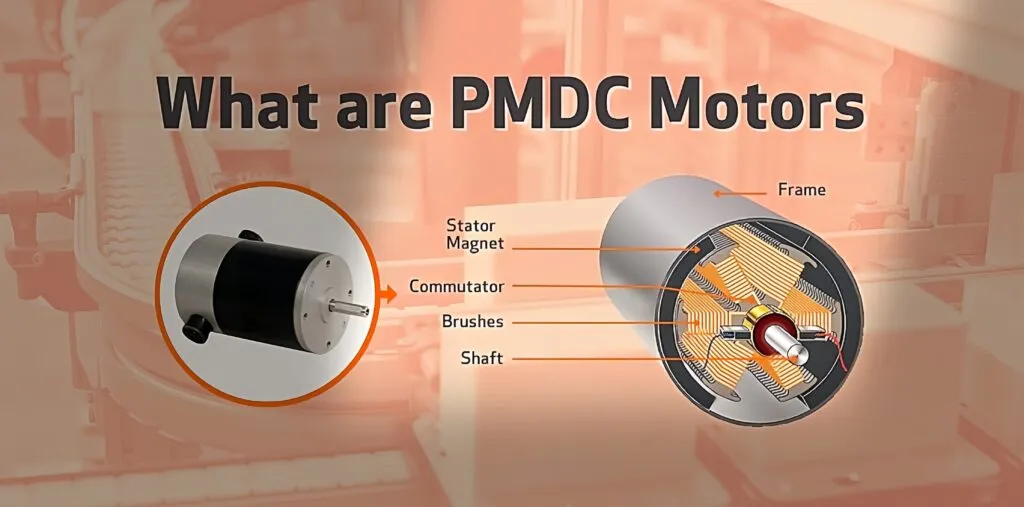
A DC motor is built from several essential components that work together to convert electrical energy into motion:
- Stator – The stationary section that provides the magnetic field, either through permanent magnets or electromagnetic coils.
- Rotor (Armature) – The rotating shaft that carries current and delivers mechanical output.
- Commutator – In brushed DC motors, it reverses current flow at the right time to keep the rotor turning.
- Brushes – Spring-loaded contacts that transfer current to the rotor (only used in brushed motors)
Brushless DC motors eliminate brushes and the commutator, reducing mechanical wear and improving service life.
Together, these components form the basic structure of a DC motor, making it simple, reliable, and adaptable for different motion control applications.

Types of DC Motors
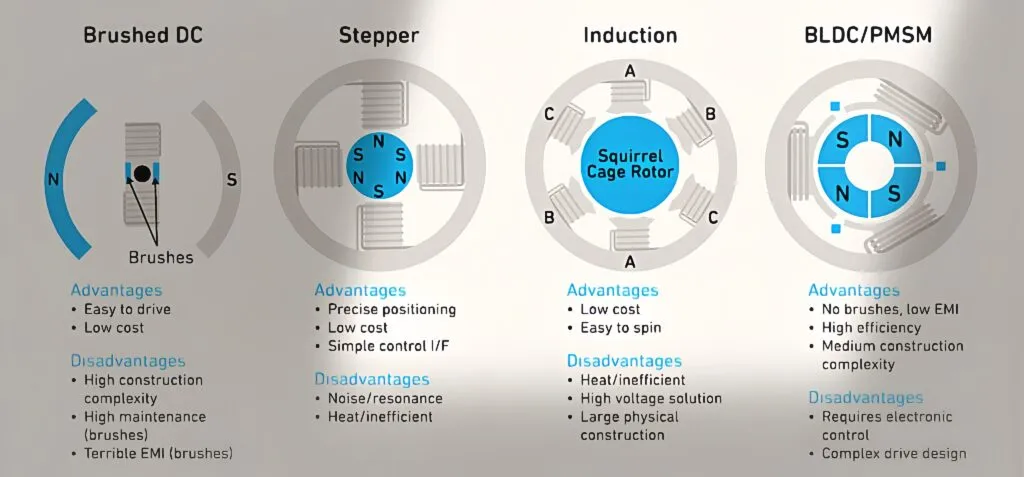
DC motors are generally classified into two main categories based on how the magnetic field is produced: Permanent Magnet DC Motors and Wound-Field DC Motors. Each type has unique working principles, advantages, and applications.
1. Permanent Magnet DC Motors (PMDC)
These motors use permanent magnets in the stator instead of field windings.
Brushed PMDC Motors
- Use brushes and a commutator to manage current direction.
- Simple, compact, and low-cost.
- Suitable for applications such as vending machines, personal appliances, and entry-level automation.
Brushless DC Motors (BLDC)
- Use electronic control to switch current, eliminating brushes.
- Higher efficiency (up to ~90%), quiet operation, and longer service life.
- Often found in medical equipment, battery-powered tools, robotics, and HVAC systems.
Note: A subtype of BLDC motors is the Stepper Motor, which moves in precise steps and provides holding torque. Stepper motors are ideal for positioning systems and robotics.
2. Wound-Field DC Motors
These motors generate the magnetic field using electromagnetic windings in the stator.
Series DC Motors
- Deliver very high starting torque, but speed varies significantly with load.
- Typically used in cranes, hoists, and automotive starters.
Shunt DC Motors
- Provide stable speed under varying loads.
- Common in conveyors, mixers, and fans where constant speed is important.
Compound DC Motors
- Combine features of both series and shunt motors, balancing torque and speed regulation.
- Suitable for presses, elevators, and packaging machinery.
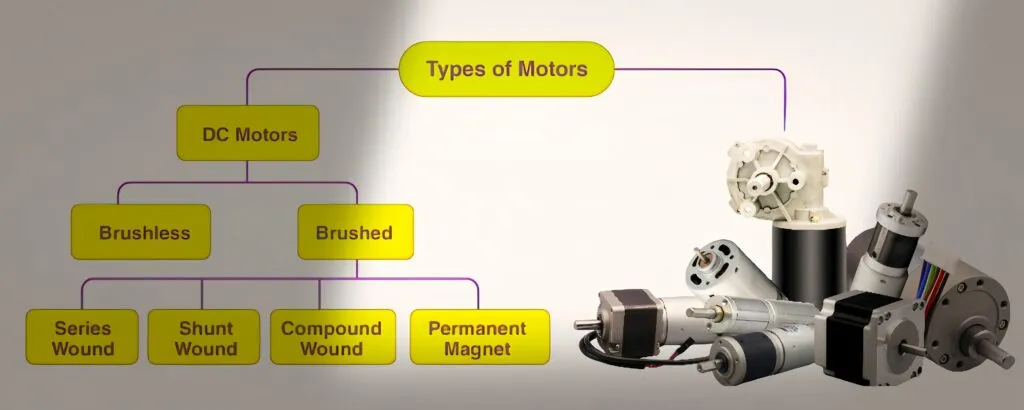
DC Motor Control: Speed, Direction & Efficiency
DC motor control is achieved by adjusting speed with voltage (or PWM) and reversing polarity for direction. In practice, speed control is often managed with pulse width modulation (PWM) for efficiency, while direction control typically uses an H-bridge circuit.
This makes DC motors straightforward to regulate and adaptable across automation, robotics, and industrial applications.
Speed Control
The speed of a DC motor is directly proportional to the applied voltage. Using PWM (Pulse Width Modulation) allows precise regulation of speed without excessive energy loss, making it the most common method in modern systems.
Direction Control
Reversing the polarity of the supply changes the rotation direction. An H-bridge driver circuit is widely used for this, enabling safe and reliable forward/reverse switching.
Brushed vs. Brushless Control
- Brushed motors allow simple, low-cost control setups, but require regular maintenance due to mechanical wear of brushes.
- Brushless motors (BLDC) rely on electronic drivers with integrated feedback, providing smoother speed regulation, higher efficiency, and longer service life.
Advanced systems may also integrate encoders or tachometers to provide feedback, ensuring stable speed and torque even under varying load conditions.
How to Choose the Right DC Motor
The right DC motor is chosen by matching torque, speed, voltage, and duty cycle to your application.
- Series motors suit heavy loads with high starting torque.
- Shunt motors provide steady speed under variable load.
- Compound motors balance torque and speed.
- PMDC motors are compact and cost-effective, while BLDC motors offer high efficiency and longer service life.
Choosing the right DC motor depends on matching torque, speed, power, and environment to the specific needs of your application. Engineers typically evaluate a few key factors before making a selection.
- Voltage availability – Match the motor voltage to your power source.
- Required torque and speed (RPM) – Define the load profile and expected performance.
- Duty cycle – Continuous or intermittent operation will influence motor sizing.
- Size and mounting constraints – Ensure compatibility with available space.
- Noise and efficiency requirements – Important for medical, consumer, and battery-powered systems.
- Operating environment – Consider exposure to dust, humidity, or temperature variations, especially for outdoor or industrial use.
General Recommendations:
| Application Need | Suggested Motor Type |
|---|---|
| Budget-sensitive, low complexity | Brushed PMDC Motor |
| Energy-efficient, compact design | Brushless DC Motor (BLDC) |
| High starting torque | Series Wound Motor |
| Consistent speed under variable load | Shunt Wound Motor |
| Torque and speed balance | Compound Motor |
| Precise positioning or holding | Stepper Motor (BLDC subtype) |
By comparing your application requirements with these motor types, you can identify the most reliable type of DC motor for your project.
Common Applications
DC motors are used in a wide range of applications, from medical devices and industrial automation to mobility systems, smart home equipment, and consumer electronics.
Some of the most common applications include:
- Medical & Laboratory: Peristaltic pumps, sample handlers, diagnostic devices, surgical tools
- Industrial Automation: Conveyors, label applicators, pick-and-place arms, packaging machines
- Mobility Systems: Electric lifts, adjustable desks and tables, rehabilitation equipment
- Home & Office Devices: Curtain systems, fans, automated kitchen tools, smart appliances
- Consumer Electronics: Drones, toys, small robots, handheld tools
- Transportation & Automotive: Electric door systems, wipers, HVAC blowers, seat adjusters
- Printing & Packaging: Label printers, cutters, and compact drives in production lines
DC motors remain essential in these sectors because they deliver reliable motion control in compact, efficient, and easily customized packages.

Conclusion
DC motors continue to be a reliable choice for motion control thanks to their simplicity, precise controllability, and dependable performance. Whether you are designing a cost-sensitive consumer product or a high-precision industrial system, understanding the different types of DC motors—and their strengths and limitations—helps ensure your application runs smoothly and efficiently.
If you’re unsure which motor best fits your project, our engineering team can work with you to review your requirements and recommend the right solution.
Explore our DC motor options or get in touch with our engineering team to start your selection process.
Learn More About DC Motors